

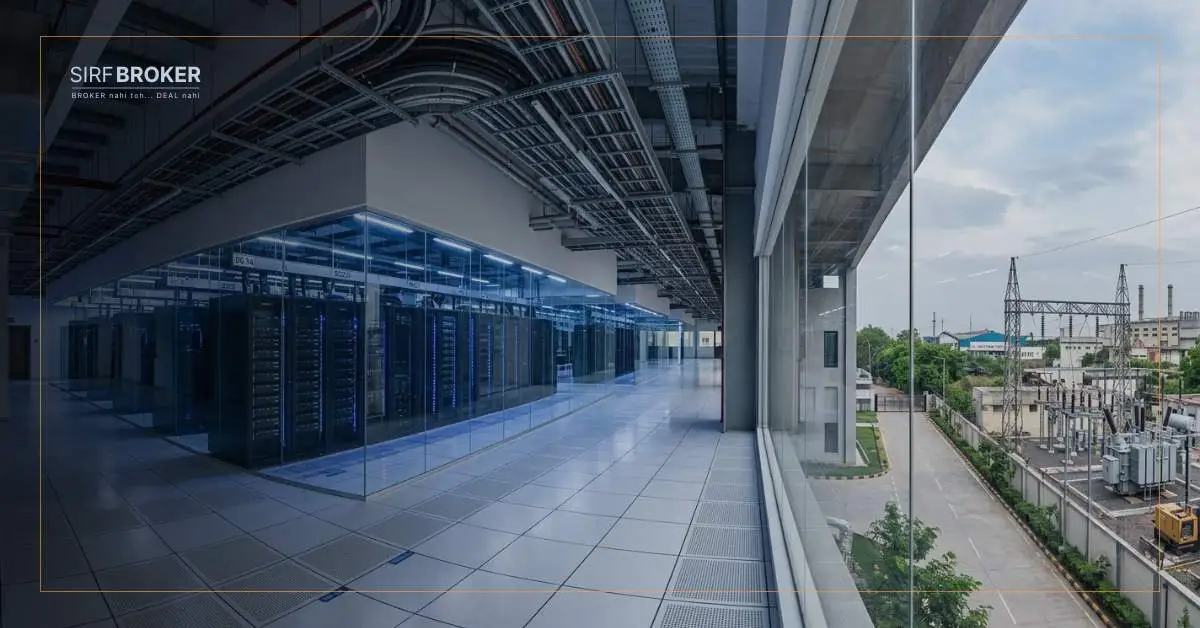
Artificial intelligence is doing something contradictory to commercial real estate globally. It is simultaneously creating demand for more space — through data centres, AI research facilities, and the infrastructure required to train and run large language models — and reducing the headcount growth that has historically driven office leasing activity. The same technology that could fill 330 million sq ft of new space globally over the next decade is also expected to flatten office-using employment growth in developed markets to its lowest rate in decades.
According to Cushman & Wakefield’s May 2026 global research, AI is projected to add approximately 330 million sq ft of new commercial real estate demand over the next ten years — the majority through data centre and AI infrastructure requirements. At the same time, office-using employment in developed markets is forecast to grow at just +0.3% annually from 2026 to 2030 — roughly half the long-term average — as AI tools absorb tasks previously handled by office headcount.
The result is a market bifurcation story: AI infrastructure real estate gains; commodity office space in labour-dependent markets faces structural headwinds. India sits on the unusual side of this divide — gaining on both counts.
The 330 MSF Demand Story: What AI Actually Needs
When Cushman & Wakefield projects 330 million sq ft of new CRE demand from AI over the next decade, it is not projecting 330 MSF of new office space. The demand is predominantly infrastructure-linked: data centres to run AI workloads, hyperscale cloud facilities to store training data, high-power warehousing for server hardware, and specialised research campuses for AI model development.
| AI-Driven CRE Demand Type | Space Requirement | Location Logic |
|---|---|---|
| Data centres | High power density; critical infrastructure | Power access, fibre, water cooling, permitting speed |
| Hyperscale cloud campuses | Massive floor plates; modular expansion | Low land cost, stable grid, sovereign data regulations |
| AI research facilities | Specialised fit-out; talent-proximate | Near university engineering clusters |
| High-power industrial | Heavy power, cooling infrastructure | Industrial corridors, special economic zones |
| GCC / AI capability offices | Grade A office + compute rooms | Talent density cities: Bengaluru, Hyderabad, Pune |
The Office Employment Headwind — And Why It Hurts the West More Than India
Cushman & Wakefield’s May 2026 research, corroborated by Newmark and PwC/ULI’s Emerging Trends in Real Estate 2026, forecasts office-using employment in developed markets will grow at just +0.3% annually from 2026–2030 — compared to a long-term average of 0.6–0.8%. AI tools are absorbing knowledge work tasks (document review, data analysis, code generation, customer service routing) that required office headcount to perform.
For US and European commercial real estate markets, this is a meaningful structural challenge. Their office markets derive demand almost entirely from domestic employment growth. If that growth slows, office leasing slows with it. India’s exposure to this headwind is more limited — and in some ways India benefits from the same trend that hurts Western markets.
Why India’s Office Market Is an AI Beneficiary, Not a Victim
The key insight: India is where global AI capability is being built. The 2,100+ Global Capability Centres in India are increasingly AI-focused — according to JLL India’s GCC Guide 2026, more than 80% of new GCC establishments in 2025–2026 are specifically creating AI, machine learning, and data engineering functions. These GCCs are not automating themselves away. They are the automation infrastructure being built for the rest of the world.
The evidence is in the leasing numbers. Despite global office employment forecasts being essentially flat, India’s office market posted a record 21.5 MSF gross leasing in Q1 2026 per JLL India — its strongest quarter ever. GCCs drove 44% of that absorption (9.1 MSF, per CBRE India). The global flat employment forecast and India’s record leasing are not contradictory. They reflect the fact that India is the destination where AI capability is being concentrated, not the location where AI is replacing jobs.
Global Q1 2026 commercial real estate investment hit $216 billion — up 18% year-on-year per JLL Global Capital Markets Q1 2026 — with Asia Pacific posting the strongest regional growth at +31%. India’s commercial real estate market was a beneficiary of this capital flow.
India’s Data Centre Market: The AI Infrastructure Play
Alongside its office market strength, India is developing one of Asia’s fastest-growing data centre markets — the direct infrastructure play on global AI investment. According to JLL India, committed investment in India’s data centre sector stands at approximately $5.7 billion, with a pipeline targeting 500 MW of new capacity per CBRE India’s India Data Centre report.
Mumbai, Chennai, Bengaluru, Hyderabad, and Delhi NCR are the five primary data centre markets. Mumbai and Chennai lead on international connectivity (submarine cable landing stations). Bengaluru and Hyderabad benefit from proximity to tech talent and existing GCC campuses. Delhi NCR expands on domestic BFSI and government digitisation demand.
⚠️ Developer Advisory Note — Data Centres: The data centre opportunity in India is real, but entry requires specialist knowledge. Power procurement (typically 5–20 MW per facility), cooling system design, redundancy architecture (Tier III minimum for commercial viability), and connectivity agreements with multiple providers are technical requirements that separate viable data centre projects from announcements. This is not a standard commercial office or industrial development play — it requires a genuinely specialist development team.
Market Bifurcation: Quality Wins, Commodity Loses
Across both global and India context, the most durable theme from AI’s impact on CRE is bifurcation. Quality assets in talent-rich, connectivity-dense markets gain demand and pricing power. Commodity assets — older office buildings in secondary locations, data centres without credible power guarantees — face structural pressure that AI adoption will accelerate, not reverse.
In India’s context: Grade A and A+ office space in Bengaluru’s ORR, Hyderabad’s HITEC City, Mumbai’s BKC, and Pune’s Hinjawadi is AI-era beneficiary real estate. Older stock in secondary submarkets without modern MEP systems is exposure, not opportunity.
Sirf Broker POV: India Is the CRE Winner of the Global AI Investment Cycle
Most global conversations about AI and commercial real estate focus on the displacement story — what happens to office demand when AI reduces headcount. That is a legitimate concern for New York, London, Frankfurt, and Sydney. It is the wrong lens for India.
India’s commercial real estate market is absorbing the AI investment cycle, not absorbing its job losses. The $5.7 billion data centre pipeline, the 80% AI-focused GCC pipeline, the record 21.5 MSF Q1 leasing — these are the physical manifestation of global multinationals betting that India is where they want to build their AI capabilities for the next decade.
The risk worth watching is not whether AI hurts India’s office market. It is whether India can match supply to demand at quality — Grade A office and data centre infrastructure with the power and connectivity that AI infrastructure requires. The countries and markets that successfully do this will define the CRE hierarchy of the 2030s. India is currently positioned to be among them.
Conclusion
AI is reshaping global CRE demand in two directions simultaneously: adding 330 MSF of new demand through infrastructure requirements (Cushman & Wakefield, May 2026), while flattening office-using employment growth in developed markets to +0.3% annually. India benefits from the first trend and is largely insulated from the second — because India’s office market runs on GCC demand for AI capability-building, not domestic employment cycles.
For investors and developers considering India’s commercial real estate market, our India REITs guide covers how institutional capital is accessing Grade A office and infrastructure assets. For occupiers and brokers navigating lease strategy in this AI-driven market, our office fit-out and leasing cost guide breaks down the full cost structure of India’s Grade A office market.
Frequently Asked Questions
Q: How much new CRE demand will AI generate globally?
A: According to Cushman & Wakefield’s May 2026 research, AI is projected to add approximately 330 million sq ft of new commercial real estate demand over the next ten years — predominantly data centres and AI infrastructure facilities, not traditional office space.
Q: Is AI hurting office demand globally?
A: AI is expected to flatten office-using employment growth in developed markets to +0.3% annually from 2026–2030 — roughly half the long-term average — as AI tools absorb tasks previously handled by office headcount. This headwind primarily affects US and European markets whose office demand depends on domestic employment growth.
Q: How is India’s office market performing despite global AI employment headwinds?
A: India posted a record 21.5 MSF gross leasing in Q1 2026 (JLL India) while global office employment forecasts are flat. India’s GCCs are where global AI capability is being built — 80%+ of new GCC establishments in 2025–2026 are specifically AI-focused (JLL India GCC Guide 2026), driving office demand that is growing, not shrinking.
Q: What is India’s data centre market size in 2026?
A: India’s data centre market has approximately $5.7 billion in committed investment (JLL India) and a pipeline targeting 500 MW of new capacity (CBRE India). Mumbai, Chennai, Bengaluru, Hyderabad, and Delhi NCR are the five primary markets.
Q: How did global CRE investment perform in Q1 2026?
A: Global CRE investment transactions reached $216 billion in Q1 2026 — up 18% year-on-year per JLL Global Capital Markets Q1 2026. Asia Pacific was the strongest-performing region at +31% growth.
Q: What CRE assets in India benefit most from AI demand?
A: Grade A and A+ office space in GCC-dominated micro-markets (Bengaluru ORR, Hyderabad HITEC City, Mumbai BKC, Pune Hinjawadi) and purpose-built data centres with credible power guarantees and connectivity. Older office stock in secondary locations without modern MEP systems faces structural headwinds from AI adoption.
Q: What is the biggest risk to India’s AI-driven CRE growth?
A: Supply-side execution: whether India can deliver Grade A office and data centre infrastructure fast enough, with the power and connectivity AI requires. Power procurement, cooling, and permitting create meaningful execution risk for developers and investors entering India’s data centre and AI infrastructure market.