

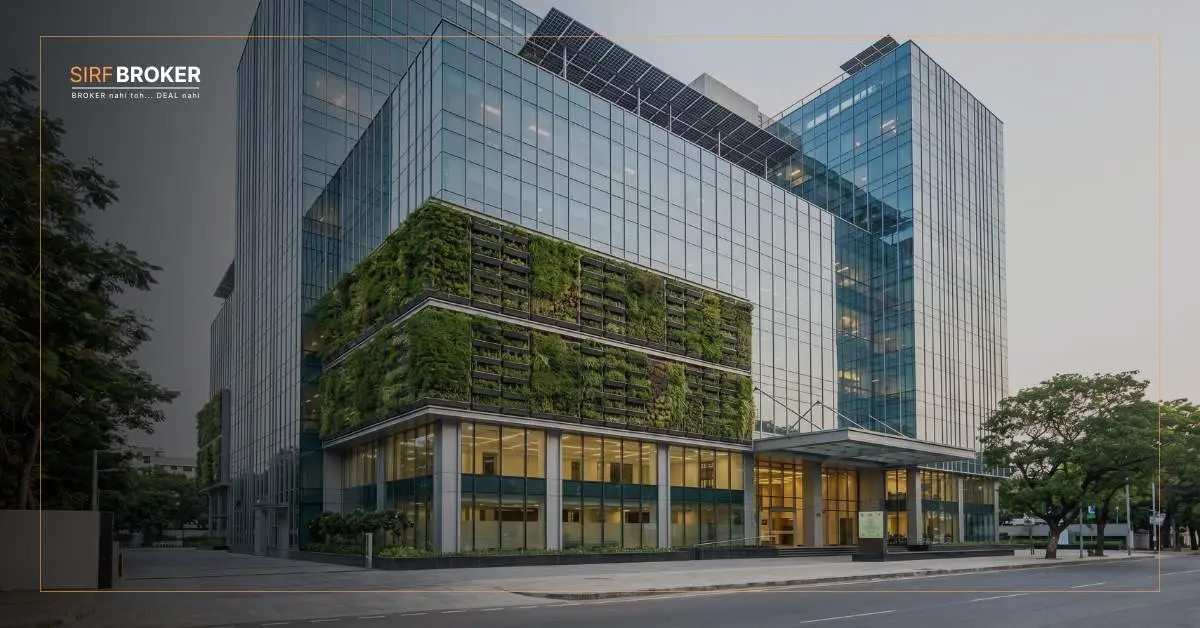
India now ranks third globally in LEED certifications — behind only the United States and China — according to CBRE India’s green building market data. The country’s total green-certified office inventory has crossed 700 million square feet. In 2024 alone, 370 projects received LEED certification covering 8.5 million gross square metres.
Those numbers tell you where the market has moved. The rent data tells you what it is worth.
Green-certified conventional office spaces in India command 18 to 22% higher rentals than comparable non-certified stock, according to CBRE India. Green-certified flexible workspace commands 47 to 50% higher rentals. The developers who understood this five years ago and built to LEED specification are not competing on price. They are competing on terms — and winning.
| LEED certification in Indian commercial real estate is no longer a premium feature that differentiates one building from another. It is the entry standard for the tenants with the longest leases and the largest fit-out budgets. GCCs will not shortlist a building without it. Institutional flex operators require it for global portfolio standards. The developer who treats it as optional is not saving on construction cost — they are eliminating themselves from the most valuable tenant pool in the market. |
The Rent Premium — What the Numbers Actually Show
The rent premium for green-certified buildings in India is not a marginal uplift. It is structural — and it is accelerating as the proportion of demand coming from GCC and institutional occupiers increases.
| Building Type | Rent Premium vs Non-Certified | Source |
|---|---|---|
| Green-certified conventional office | 18–22% higher | CBRE India green building market data |
| Green-certified flexible workspace | 47–50% higher | CBRE India green building market data |
| Energy savings — green vs standard | 30–50% reduction in energy consumption | IGBC / LEED India performance data |
| India global LEED ranking | 3rd globally — behind USA and China only | CBRE India / GBCI India 2024 data |
| Total green-certified office inventory | 700+ million sq ft (LEED: 81%, IGBC: 9%) | CBRE India 2025 |
The 30 to 50% energy savings in green-certified buildings are not just an operational benefit for tenants. They are a recurring cost advantage that tenants price into lease decisions — and a growing ESG reporting requirement for multinational occupiers who must account for the carbon footprint of their Indian operations to global parent boards.
Why GCCs and MNCs Will Not Sign Without LEED
The critical dynamic driving green building premiums in India is not buyer preference. It is procurement policy.
Global Capability Centres and multinational corporations operating in India are subject to their parent companies’ global real estate standards — standards written in New York, London, or Amsterdam, applied to every building in every country. Those standards specify sustainability certification requirements. A building without LEED Gold or Platinum (or equivalent IGBC certification) does not pass the procurement filter — it is never shortlisted, regardless of how competitive the rent is.
| This is the mechanism developers most consistently misunderstand. GCCs and MNCs are not choosing green buildings because they like them. They are choosing green buildings because their global compliance frameworks require it. The Indian real estate broker presenting a non-certified building to a GCC tenant representative is presenting a building that will never make the shortlist — at any price. The question is not “how much extra will the tenant pay for green?” The question is “will the tenant consider the building at all?” |
Where India’s Green Office Stock Is Concentrated
| City | Share of Green Office Stock | Implication |
|---|---|---|
| Bengaluru | 30% of India’s green office stock | Highest concentration — non-certified buildings significantly disadvantaged for GCC demand |
| Mumbai | 15% of India’s green office stock | Strong — BKC and western suburbs well-certified |
| Hyderabad | 14% of India’s green office stock | Hitech City / SBD well-covered; new supply should maintain standard |
| Pune | 12% of India’s green office stock | Growing — Kharadi and Hadapsar corridors expanding certified supply |
| Gurugram | 11.5% of India’s green office stock | Cyber City well-certified; Golf Course Road mixed — verify by building |
What LEED and IGBC Certification Actually Requires — The Developer Checklist
| BUILDING TO LEED GOLD: WHAT THE STANDARD REQUIRES Energy efficiency → 30–50% energy reduction vs baseline through efficient HVAC, building envelope design, LED lighting, and building management systems. This is the highest-weighted category. Water efficiency → Low-flow fixtures, water recycling systems, and rainwater harvesting. Increasingly non-negotiable in water-stressed Indian cities. Sustainable materials → Certified sustainable materials in construction, low-VOC finishes, locally sourced where possible. Design-stage decision — cannot be retrofitted. Indoor environment quality → Air quality monitoring, thermal comfort systems, natural daylight access, acoustic performance standards. GCC tenants cite this as employee retention-linked. Site sustainability → Transport connectivity to public transit, EV charging provision, reduced site footprint, management of construction waste. Site selection decision. Innovation credits → Solar rooftop provision, green roof, WELL Building features. These push a Gold project toward Platinum and further expand the eligible tenant pool. LEED certification is a design-stage decision, not a post-construction add-on. Attempting to certify a building designed without the sustainability brief costs 3–5x more and often achieves only Silver rather than Gold. |
The Developer Economics — Does the Premium Justify the Cost?
The construction cost premium for building to LEED Gold versus a standard Grade A specification is typically in the range of 5 to 12% of construction cost, depending on the design choices made at the brief stage. For a 500,000 sq ft office building with a construction cost of ₹2,500 per sq ft, that is an additional ₹6.25 to 15 crore in construction investment.
| The payback arithmetic is clear. A 500,000 sq ft office building at a base rent of ₹85/sq ft/month generates ₹51 crore per year. An 18% green premium at ₹100/sq ft/month generates ₹60 crore per year — ₹9 crore additional annual rental income. The construction cost premium of ₹6–15 crore is recovered in under 24 months of occupancy. At a 47–50% flex premium, the payback is faster still. The developer who frames green certification as a cost rather than a yield multiplier is doing the wrong calculation. |
For developers tracking how green-certified assets are being valued in REIT portfolios and institutional transactions, the overview of how REITs are changing real estate investing in India is directly relevant — REIT fund managers are applying green certification as a portfolio quality filter that affects both acquisition price and exit liquidity.
Sirf Broker POV
The green building conversation in Indian commercial real estate has been stuck in the wrong frame for too long. Developers ask: “How much extra does LEED cost?” Tenants ask: “Is this building on our shortlist?” Those are fundamentally different questions.
The 47 to 50% rental premium for green-certified flex spaces is not a reward for environmental responsibility. It is the market pricing of tenant demand concentration. The tenants paying top-of-market rents — GCCs, MNC occupiers, institutional flex operators — have non-negotiable global procurement standards that require sustainability certification. They are not paying extra for green. They simply will not pay at all for non-green. The premium exists because of demand concentration, not because tenants are altruistic.
What this means for a developer in 2026 is simple: you are not choosing between a green building and a cheaper building. You are choosing between a building that accesses the highest-value tenant pool and one that doesn’t. India’s office market is bifurcating — not just on floor plate size and location, but on certification status. The vacancy that is accumulating in older Grade A stock is not random. It is concentrated in buildings that cannot offer what the dominant demand segment requires.
Build to LEED Gold from the design brief. Not because it is the right thing to do — though it is — but because the payback is measured in months, not years, and the exit options through REIT acquisition or institutional sale are materially better for a certified asset than a non-certified one.
Conclusion
India’s green building market has matured from a niche sustainability story to a mainstream commercial real estate pricing mechanism. The 18–22% rent premium for certified conventional offices and 47–50% for certified flex spaces are not projections — they are current market data from CBRE India. The developers integrating LEED certification into their standard development brief are not building premium buildings. They are building the standard that the market’s strongest tenants now require as a baseline.
For brokers helping developer clients understand what specification tenants actually demand — including sustainability — the guide on the real cost of moving offices covers the full picture of what Grade A tenants expect, beyond just the rent line.
Frequently Asked Questions
1. What is LEED certification and why does it matter for Indian office buildings?
LEED (Leadership in Energy and Environmental Design) is an internationally recognised green building certification system administered by the US Green Building Council and GBCI. In India, LEED-certified office buildings command 18–22% higher rents than non-certified comparable stock, and green-certified flexible workspaces command 47–50% premiums, according to CBRE India data. India ranks third globally in LEED certifications, with over 700 million sq ft of green-certified office inventory.
2. What is the difference between LEED and IGBC certification in India?
LEED is the US Green Building Council’s global certification standard. IGBC (Indian Green Building Council) is the Indian equivalent, administered by the Confederation of Indian Industry (CII). Both are internationally recognised. LEED accounts for 81% of India’s green-certified office inventory; IGBC accounts for 9%. For multinational tenants with global procurement standards, both are accepted — though some MNCs specifically require LEED Gold or Platinum in their briefs.
3. How much does LEED certification add to construction costs?
Building to LEED Gold specification typically adds 5 to 12% to standard Grade A construction costs, depending on design choices made at the brief stage. This premium is significantly lower when green features are integrated at the design stage rather than retrofitted. On a 500,000 sq ft building at ₹2,500/sq ft construction cost, the additional investment is approximately ₹6–15 crore — recoverable in under 24 months given the 18–22% rent premium.
4. Which Indian cities have the most green-certified office stock?
Bengaluru leads with 30% of India’s total green office stock, followed by Mumbai (15%), Hyderabad (14%), Pune (12%), and Gurugram (11.5%), according to CBRE India data. In Bengaluru particularly, the GCC demand concentration means non-certified buildings in the ORR and Whitefield corridors face significant competitive disadvantage.
5. Why do GCC tenants require LEED-certified buildings?
GCCs (Global Capability Centres) operate under their parent company’s global real estate standards, which include mandatory sustainability certification requirements. These standards are written at a global level and applied uniformly — a building without LEED Gold or Platinum does not pass the procurement filter regardless of rental competitiveness. It is not a preference; it is a compliance requirement that determines shortlisting before any broker or developer is called.
6. Can an existing non-certified office building be upgraded to LEED certification?
Yes — through LEED for Existing Buildings (LEED EB:O+M). However, retrofitting LEED certification to an existing building is significantly more expensive and technically complex than building to LEED specification from the design stage. Retrofitted buildings typically achieve Silver rather than Gold. The most cost-effective path to certification is always design-stage integration, which is why the certification decision must be made at the brief, not after the shell is built.
7. What is WELL Building certification and how does it relate to LEED?
WELL Building Standard focuses specifically on human health and wellness within built environments — air quality, water quality, lighting, thermal comfort, acoustics, and mental health features. LEED focuses on environmental sustainability and energy efficiency. The two certifications are complementary — many premium Indian office buildings are pursuing both simultaneously, particularly those targeting MNC and GCC tenants with global ESG and employee wellbeing commitments. Dual-certified buildings command the highest rents and institutional valuations.
Sources and References
- CBRE India — Green Building Market Data 2025/2026 — 18–22% rent premium conventional; 47–50% flex premium; India 3rd globally LEED; 700mn sq ft green inventory; Bengaluru 30% share; Mumbai 15%; Hyderabad 14%; Pune 12%; Gurugram 11.5%. cbre.co.in
- GBCI India / LEED India — 370 projects LEED-certified in 2024; 8.5 mn gross sq mt; LEED at 81% of green office stock. gbci.org/india
- IGBC (Indian Green Building Council) — IGBC Green certification standards and India green building statistics. igbc.in
- Colliers India — 2026 India Real Estate Outlook — GCC specification requirements including sustainability certification. colliers.com/en-in
Disclaimer
| This article is published by Sirf Broker for educational and informational purposes only. It is not investment or development advice. Rent premiums, construction cost estimates, and certification requirements vary by building, location, specification, and market conditions. All data is sourced from publicly available reports cited above. Developers should conduct independent feasibility analysis and consult qualified professionals before any development decision. |