

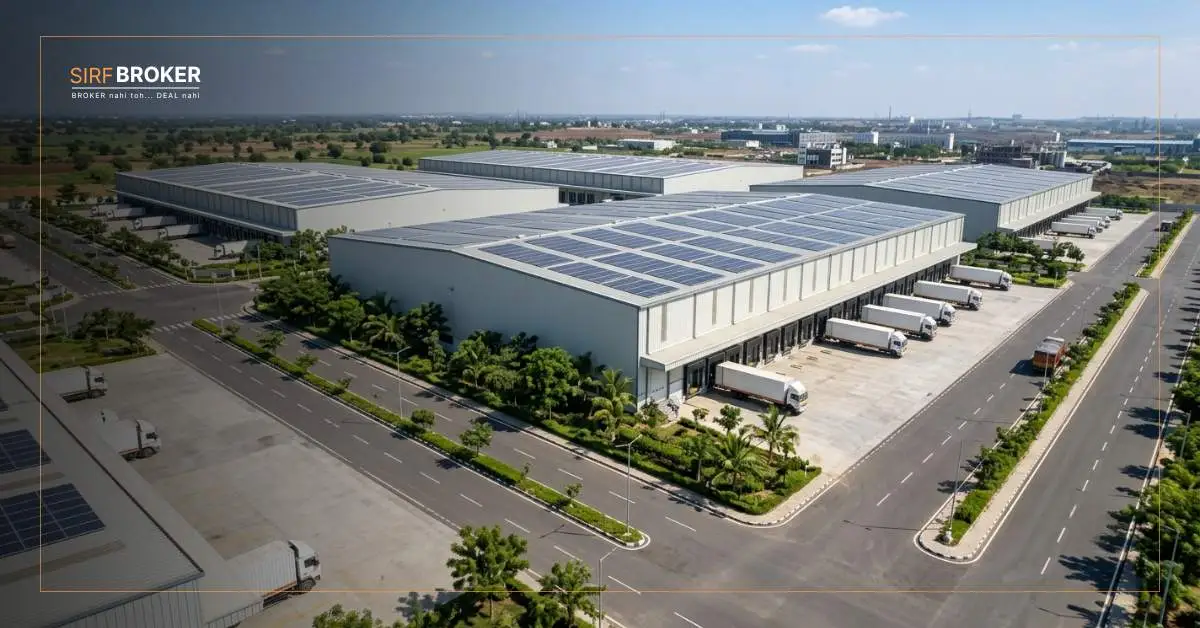
The Indian warehousing market did not have a dramatic H1 2026. No structural disruption, no crisis, no sudden reversal. What it had was a steady, deepening maturation — and one number that defines where the market is heading.
In H1 2026, Grade A warehousing accounted for 59% of total absorption across India, up from 55% in H1 2025, according to CBRE India’s Logistics Market Outlook 2026. That 4-percentage-point shift may sound modest. It is not. In a market that absorbed 34.8 million sq ft in just six months, a 4-point shift in quality mix represents millions of square feet of demand moving from Grade B and Grade C facilities to Grade A.
The flight to quality in Indian warehousing is not a preference — it is an accelerating structural demand shift that developers still building Grade B assets in Tier-I cities are going to regret.
The H1 2026 Numbers
Total warehousing and industrial absorption across India in H1 2026: 34.8 million sq ft — a 2.4% year-on-year increase, per CBRE India’s Logistics Market Outlook 2026 and Colliers India. Fresh supply delivered in H1 2026: 42.7 million sq ft. Of this, Tier-I cities accounted for 36.7 million sq ft (86% of total supply). Supply outpaced absorption — meaning vacancy has risen modestly. But the vacancy is not uniform: Grade A space continues to lease at high occupancy, while Grade B/C space absorbs the overhang.
Grade A inventory as of H1 2026: 293 million sq ft — up 20% year-on-year — now representing 57% of total national inventory. Three years ago, this figure was below 50%. The stock composition of Indian warehousing is shifting because occupiers are demanding it.
| Metric | H1 2025 | H1 2026 | Change |
|---|---|---|---|
| Total absorption (MSF) | ~34.0 | 34.8 | +2.4% |
| Grade A share of absorption | 55% | 59% | +4pp |
| Grade A inventory (MSF) | ~244 | 293 | +20% |
| Grade A as % of total stock | ~52% | 57% | +5pp |
| Fresh supply (MSF) | — | 42.7 | — |
| Tier-I share of fresh supply | — | 86% | — |
Sources: CBRE India Logistics Market Outlook 2026; Colliers India H1 2026 Industrial & Warehousing Report
Who Is Driving the Demand?
Manufacturing led at 30% of absorption. This reflects the ongoing relocations and expansions driven by Production Linked Incentive (PLI) schemes across 14 sectors — electronics, pharmaceuticals, auto components, textiles, specialty chemicals — and the China+1 supply chain shift. Manufacturing occupiers are the most specification-demanding segment: they require Grade A facilities with precise clear heights, controlled environments, and regulatory compliance that Grade B warehouses cannot provide.
Third-party logistics (3PL) followed at 23%. 3PL players have been the defining demand driver in Indian Grade A warehousing for three years. Their shift to large-format Grade A facilities — deals of 200,000 sq ft or above are expected to drive 40-50% of Grade A absorption in 2026, per Colliers — is what has made Grade A the dominant leasing format. FMCG and FMCD contributed 18% of demand, e-commerce 10%.
What Defines Grade A — and Why It Now Matters More Than Location
Grade A warehousing in India is defined by: clear internal height of 10-12 metres or above; dock-levellers at all loading bays; fire protection system (sprinklers, hydrants, NOC from fire authority); 24/7 CCTV and perimeter security; power backup (DG sets or solar); clean, defined traffic circulation (separate inbound/outbound lanes); and ESG-compliant design (energy efficiency, rainwater harvesting, solar-ready roofing).
Why does this matter more now than before? Three converging pressures. First, multinational and large Indian manufacturers insist on specifications meeting global operational standards — a warehouse without minimum clear height cannot accommodate their racking systems. Second, FSSAI food safety regulations and pharma cold chain compliance require documentation of facility standards that Grade B facilities cannot provide. Third, ESG reporting requirements on large corporates are cascading down to their supply chains — occupiers must disclose the sustainability credentials of their warehouse facilities to their own clients.
Where the Development Opportunity Is
Tier-I cities are well-supplied. Supply delivered in Tier-I was 36.7 MSF in H1 2026 alone — against 34.8 MSF of total absorption. Vacancy in Tier-I is present, particularly in secondary locations. The opportunity is not in adding more Grade A supply to saturated Tier-I locations. The opportunity is in the Tier-II and Tier-III corridors that are receiving manufacturing demand driven by PLI and supply chain diversification, but where Grade A supply is still scarce.
| Corridor | State | Primary Demand Driver | Grade A Supply Gap |
|---|---|---|---|
| Sriperumbudur / Hosur | Tamil Nadu | Electronics, EV manufacturing | High |
| Ludhiana / Ambala | Punjab / Haryana | Automotive, agri-processing | High |
| Dahej / Bharuch | Gujarat | Chemicals, petrochemicals | Moderate-High |
| Vishakhapatnam | Andhra Pradesh | Pharma, port logistics | High |
| Nagpur | Maharashtra | Multi-modal logistics hub | Moderate |
Sirf Broker POV: Grade A Is No Longer Premium Positioning. It’s the Entry Ticket.
The warehousing developers most exposed right now are not the ones who over-built in the wrong city. They are the ones who built Grade B facilities in Tier-I cities on the assumption that “good enough” would lease. That assumption is not holding.
The occupier who leased a Grade B warehouse three years ago because Grade A was too expensive has, in the intervening time, grown large enough to need compliance documentation for their FMCG multinational client, or to integrate their racking system with an automated WMS, or to certify their cold chain for a pharma export client. That occupier is now in the market for Grade A — and they are not looking at their current landlord’s other buildings.
For brokers working in the industrial and warehousing space, the practical implication is this: when advising a developer client on what to build, Grade A is not a product differentiation strategy any more. It is the minimum required to lease to the 30% of demand that is manufacturing and the 23% that is 3PL. Anything below Grade A is competing for a shrinking pool of price-sensitive occupiers who do not need compliance documentation, multi-level racking, or audit trails.
The development opportunity in 2026 is not more Tier-I Grade A. It is being the first institutional-grade developer in a Tier-II corridor where manufacturing demand is real but Grade A supply does not yet exist. That is where the yield premium will be created over the next five years.
Conclusion
The Indian warehousing market’s flight to quality is a structural demand shift, not a cyclical preference. For brokers advising manufacturing or logistics clients on site selection, our commercial leasing mistakes guide covers the due diligence errors that derail even well-intentioned transactions. For how institutional capital is flowing into Indian real estate assets including warehousing, our REITs and investment vehicles guide explains how these assets are increasingly packaged for investment.
Frequently Asked Questions
Q: How much warehousing space was absorbed in India in H1 2026?
A: India’s industrial and warehousing sector recorded total absorption of 34.8 million sq ft in H1 2026 — a 2.4% year-on-year increase. Grade A facilities accounted for 59% of absorption, up from 55% in H1 2025. Source: CBRE India Logistics Market Outlook 2026; Colliers India.
Q: What is Grade A warehousing in India?
A: Grade A is defined by: clear internal height of 10-12 metres or above, dock-levellers at all loading bays, fire protection systems (sprinklers, fire NOC), 24/7 security, power backup, clean traffic circulation, and ESG-compliant design. These meet the operational requirements of multinational manufacturers, large 3PL operators, and companies with compliance and sustainability reporting obligations.
Q: Which sectors are driving warehousing demand in India in 2026?
A: Manufacturing leads at 30% (PLI and China+1 driven), followed by 3PL at 23%, FMCG and FMCD at 18%, and e-commerce at 10%. Manufacturing and 3PL together are the primary drivers of Grade A absorption.
Q: How much Grade A warehousing inventory does India have?
A: 293 million sq ft as of H1 2026 — up 20% year-on-year — representing 57% of total national warehousing stock, up from approximately 52% three years ago.
Q: Which cities have the most warehousing supply in India?
A: Tier-I cities (Delhi NCR, Mumbai, Bengaluru, Hyderabad, Pune, Chennai) account for 86% of fresh supply delivered in H1 2026. However, supply has outpaced absorption in Tier-I. Development opportunity is increasingly in Tier-II manufacturing corridors where Grade A supply is scarce.
Q: Why are warehousing rentals continuing to rise despite new supply?
A: Grade A rentals maintain upward momentum because compliant Grade A supply in prime locations does not fully meet demand. Grade B rentals face pressure as occupiers migrate up the quality curve. The gap creates a widening rental premium for Grade A over Grade B.
Q: Where is the best warehousing development opportunity in India for 2026?
A: Not in saturated Tier-I cities. The opportunity is in Tier-II manufacturing corridors with PLI-driven demand and limited Grade A supply — specifically Sriperumbudur/Hosur (electronics, EV), Ludhiana/Ambala (automotive, agri), Dahej/Bharuch (chemicals), and Vishakhapatnam (pharma, port logistics).