

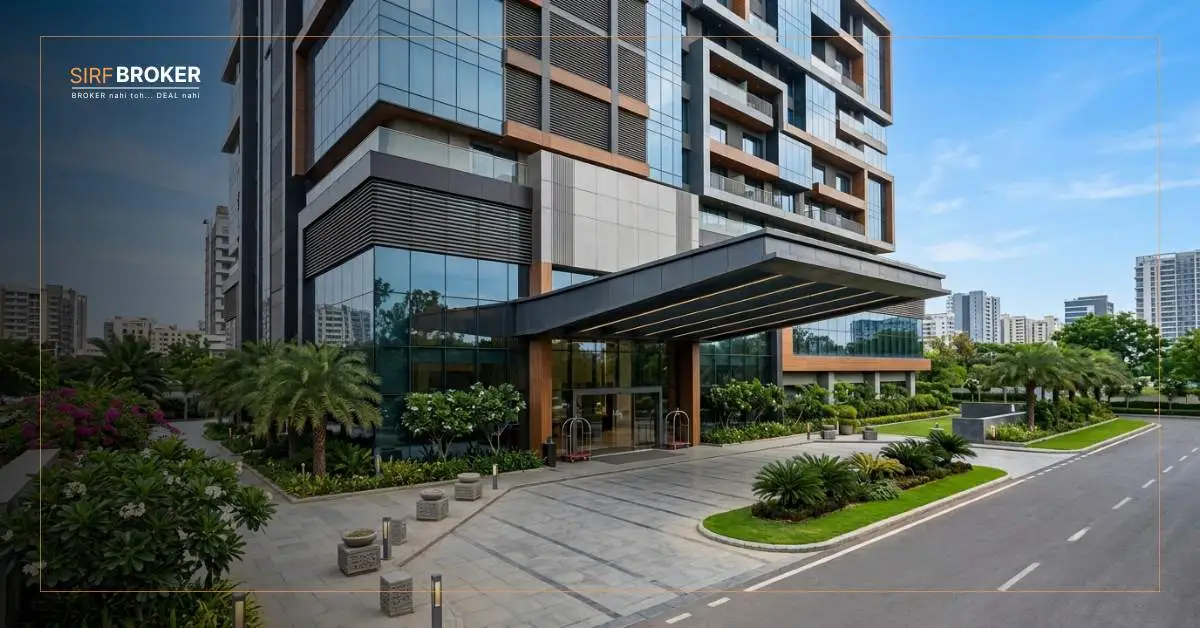
India’s hotel and hospitality real estate sector attracted $185 million in investment in Q1 2026 alone — up 58% year-on-year — putting the full year on track to cross $1 billion in total hotel transactions for the first time in the country’s real estate history, according to JLL India’s Q1 2026 Hotel Investment Report.
For context: the entire calendar year 2025 saw $567 million in hotel transactions — itself a 67% jump over 2024. The $1 billion projection for 2026 represents a near-doubling from a year that was already a record. What is driving this momentum matters as much as the number itself — because the drivers are structural, not speculative, and they are pointing to asset classes and geographies that most Indian real estate participants are not yet paying close attention to.
This is not the story of luxury hotels in Mumbai and Delhi filling up with foreign tourists. It is the story of domestic business travel, airport corridor land monetisation, and institutional PE capital discovering that Indian hospitality real estate is one of the few segments with a genuine supply-demand imbalance at the quality end of the market.
| $185M hotel investment in Q1 2026. +58% YoY. $567M in full-year 2025 (+67% over 2024). $1 billion target for 2026 — a first-ever. Tier 1 cities: 60%. Tier 2/3 cities: 40% of volume. Source: JLL India, Hospitality Biz India 2026. |
The Demand Story Behind the Investment Numbers
Hotel investment does not lead demand — it follows it. The reason institutional capital is flowing into India’s hospitality segment at record levels is that the underlying demand metrics justify it. India’s hotel industry has delivered consistent occupancy improvements in 2024 and 2025, with premium business hotels in Tier 1 cities posting average occupancy rates above 70% and Average Daily Rates (ADR) rising faster than general inflation.
Three demand drivers are sustaining this:
| Demand Driver | What’s Happening | Real Estate Implication |
|---|---|---|
| Domestic Business Travel | GCC expansion, MNC India operations, MSME supply chains — all generating consistent corporate travel demand | Business hotels near employment zones in Bengaluru, Pune, Hyderabad, NCR are running at high occupancy year-round |
| Domestic Leisure Tourism | Rising middle-class aspirational travel, long weekends, wedding travel — all driving demand for mid-scale and upscale hotels in leisure destinations | Tier 2 leisure cities — Udaipur, Coorg, Rishikesh, Goa secondary zones — seeing resort hotel development acceleration |
| Airport Infrastructure | New airports opening in Jewar, Navi Mumbai, Mopa Goa, Itanagar, Deoghar — each creating an immediate hotel demand zone around the terminal | Airport-adjacent hotel plots are the sharpest near-term land appreciation opportunity in Indian hospitality real estate |
Source: JLL India Hotel Investment Report Q1 2026; Hospitality Biz India 2026; India’s hotel transaction market tracking: Nomad Lawyer / GRI Institute 2026.
The Tier 2 and 3 Shift
The most strategically significant aspect of India’s hotel investment surge is geographic: Tier 2 and Tier 3 cities now account for 40% of hotel investment volume, with Tier 1 cities contributing 60%. This 40% Tier 2/3 share is substantially higher than in any prior period of Indian hotel investment.
| WHY TIER 2 AND TIER 3 HOTEL INVESTMENT IS ACCELERATING Supply gap → Tier 2 and 3 cities have almost no branded hotel supply. A business traveller visiting Lucknow, Coimbatore, Bhubaneswar, or Raipur for a corporate meeting has a thin choice set at the branded, quality-assured level. That scarcity means occupancy and ADR for early-mover branded hotels are structurally higher than in oversupplied Tier 1 markets. Government infrastructure → UDAN scheme airports, Smart City development, and government land auctions near new infrastructure hubs — Yashobhoomi, Neopolis (Hyderabad), Chennai Fintech City, Jewar Airport — are creating serviced land opportunities for hospitality development that did not exist two years ago. Lower land cost → Hotel development economics work better in Tier 2 cities because land cost as a percentage of total development cost is dramatically lower than in Mumbai, Bengaluru, or Delhi. A 150-key business hotel in Lucknow has a development cost structure that pencils out; the same hotel in BKC requires occupancy assumptions that are genuinely heroic. |
For developers and brokers who understand hospitality real estate, the Tier 2 opportunity is the most actionable implication of the 2026 investment surge. The institutional capital going into Tier 2 hotel deals is validating site selection in cities where local brokers and developers have had few templates to follow.
The Deals Defining the Market
Two transactions from H1 2026 tell the story of who is buying and what they believe.
Warburg Pincus invested $107 million to acquire a 41% stake in Fleur Hotels, a subsidiary of Lemon Tree Hotels. Warburg Pincus is not a tourist. It is one of the world’s most analytically rigorous PE funds. Its commitment to an India mid-scale hotel platform reflects a conviction that the branded mid-market hotel segment in India — business hotels in the ₹5,000-12,000 per night range — is structurally undersupplied relative to the corporate demand it serves.
| Institutional investors and private equity firms dominated hotel transactions in H1 2026, followed by high-net-worth individuals, family offices, and listed hotel companies. This investor profile — heavy on institutional capital at the top — signals that hospitality real estate has cleared the institutional due diligence test. The risk-adjusted return profile of branded hotel assets with stable occupancy and escalating ADR is now competitive with commercial office income, particularly in markets with no competing supply. |
Airport land monetisation projects are creating the second deal type of 2026. Government-led land auctions near Yashobhoomi (Delhi’s new convention complex), Neopolis (Hyderabad’s upcoming tech park), Chennai’s Fintech City, and Jewar Airport are generating hotel development plots at prices that institutional developers can underwrite. These are not speculative land plays — they are infrastructure-anchored hospitality developments with visible demand drivers.
What Brokers and Developers in Hospitality Real Estate Need to Know
Hospitality real estate requires different skills from residential or commercial brokerage. The due diligence process, valuation methodology, and transaction structuring are all distinct — and most brokers who stumble into a hotel deal for the first time discover this the hard way.
Hotel assets are valued on income capitalisation — Revenue Per Available Room (RevPAR), Average Daily Rate, and occupancy rate — not on comparable transaction prices per sq ft. A broker advising a developer or investor on a hotel acquisition who does not understand these metrics cannot conduct meaningful due diligence or negotiate effectively on the buyer’s behalf.
The second difference: hotel transactions often involve brand agreements, management contracts, or lease structures with hotel operators (Marriott, IHG, Radisson, Lemon Tree, IHCL) that are separate from the real estate transaction. The broker who understands how a management contract affects the asset’s value — and what the differences between a management contract, a lease, and a franchise agreement mean for the investor’s returns — is operating at a level where the professional fee is genuinely earned.
For brokers looking to enter the commercial property advisory segment that underpins hospitality demand, building knowledge of commercial leasing fundamentals is the foundation: Common Mistakes in Commercial Property Leasing Deals.
Sirf Broker POV
The $1 billion hotel investment milestone matters for Indian real estate in a way that goes beyond the hospitality sector. It signals that institutional capital — which is fundamentally rational about where it allocates — has identified a supply-demand imbalance in India’s branded hotel market that it believes is large enough and durable enough to justify committed capital at scale.
The supply-demand imbalance is real. India’s branded hotel room count per capita is a fraction of comparable economies at similar income levels. The GCC boom — which is bringing tens of thousands of foreign and domestic corporate travellers to Bengaluru, Pune, Hyderabad, and NCR every quarter — is not matched by branded hotel supply. The domestic leisure travel surge — middle-class India discovering the weekend break, the destination wedding, the mountain resort — is happening in cities and towns where the branded supply is 5-10 rooms deep in a city that can absorb 50.
For developers and brokers who engage seriously with this market, the opportunity is not just transactional. The broker who becomes the specialist in hospitality land parcels in airport corridors and Tier 2 business cities — who understands what site characteristics institutional hotel developers require, who knows the government land auction calendars, who has relationships with hotel brand development teams — is positioning themselves in a niche that will generate significant deals over the next five years. The generalist broker who sees a hotel plot and doesn’t know where to start will refer it away. One of them will look back on 2026 as the year the hospitality opportunity was right in front of them.
Conclusion
India’s hotel real estate investment market is tracking toward $1 billion in 2026 — the first time the sector has reached this milestone. The drivers are structural: domestic business travel, domestic leisure tourism, airport infrastructure expansion, and institutional capital discovering a market with genuine supply scarcity at the quality level. The Tier 2 and 3 opportunity — where 40% of investment is now going — is the sharpest near-term play, with branded mid-scale business hotels in undersupplied cities offering occupancy and ADR dynamics that Tier 1 markets cannot match.
For developers raising capital for hospitality projects, understanding how institutional capital underwrites hotel assets — income capitalisation, RevPAR benchmarks, brand agreement structures — is the prerequisite for accessing the $1 billion market. For brokers seeking to enter the hospitality advisory segment, building that same knowledge base is what separates a specialist from a generalist in a sector that rewards specialisation heavily.
To understand the broader institutional investment environment driving capital into India’s real estate sector, read: REITs Are Changing Real Estate Investing: What Brokers Must Learn.
Frequently Asked Questions
1. How much has hotel real estate investment grown in India in 2026?
India’s hotel sector attracted $185 million in investment in Q1 2026, up 58% year-on-year, per JLL India. Full-year 2025 saw $567 million in hotel transactions (up 67% over 2024), and the 2026 full-year projection targets $1 billion — which would be the highest figure in India’s real estate history for the hospitality segment.
2. What is driving India’s hotel investment surge in 2026?
Three structural drivers: domestic business travel growth (fuelled by GCC expansion and MNC India operations), domestic leisure tourism surge (rising middle-class aspirational travel), and airport infrastructure development (new airports in Jewar, Navi Mumbai, Mopa Goa, and others creating immediate hotel demand zones). Institutional PE capital is following these demand signals.
3. What is the biggest hotel investment deal in India in 2026?
Warburg Pincus invested approximately $107 million to acquire a 41% stake in Fleur Hotels, a subsidiary of Lemon Tree Hotels, betting on the branded mid-scale business hotel segment’s structural under-supply relative to corporate demand. Government-led land auctions near Yashobhoomi (Delhi), Neopolis (Hyderabad), Chennai Fintech City, and Jewar Airport are also generating major hospitality development deals.
4. Why are Tier 2 and Tier 3 cities attracting hotel investment in India?
Tier 2 and 3 cities now account for 40% of India’s hotel investment volume. The drivers: acute branded supply scarcity (meaning early-mover branded hotels run at high occupancy with strong ADR), lower land cost (making development economics viable), government infrastructure investment (UDAN airports, Smart City programs), and growing domestic corporate and leisure demand from India’s expanding middle class.
5. How are airports driving hotel development in India?
New airports in Jewar (Noida), Navi Mumbai, Mopa (Goa), and elsewhere are creating immediate hotel demand zones. Government-led land auctions near airport precincts — including Yashobhoomi, Neopolis, and Jewar — are providing serviced land at underwritable cost for institutional hotel developers. Airport-adjacent hotel plots are among the sharpest near-term land appreciation plays in Indian real estate.
6. How is hotel real estate valued differently from residential or commercial property?
Hotel assets are valued on income capitalisation — Revenue Per Available Room (RevPAR), Average Daily Rate (ADR), and occupancy rate — not on per-sq-ft comparable transaction prices. Hotel transactions also typically involve separate brand agreements (management contracts, leases, or franchise agreements with hotel operators) that directly affect asset returns. Brokers and developers entering hospitality real estate must understand both valuation methodology and brand agreement structures to operate effectively.
Sources and References
- JLL India — Q1 2026 Hotel Investment Report — $185M Q1 2026 +58% YoY; Warburg Pincus $107M into Fleur Hotels; full-year 2026 tracking toward $1B. jll.co.in
- Hospitality Biz India — 2026 — India hotel investments rise 58% in Q1 2026. hospitalitybizindia.com
- IBEF — 2026 — India’s hotel sector attracts $185 million in Q1, up 58%: JLL. ibef.org
- Nomad Lawyer / GRI Institute — 2026 — India eyes record $1 billion hotel transactions in 2026; decoding the Indian hotel investment boom. nomadlawyer.org / griinstitute.org
- Whalesbook — 2026 — Indian real estate attracts $4.5B in H1 2026; hospitality tripled in institutional investment share. whalesbook.com
Disclaimer
| This article is published by Sirf Broker for educational and informational purposes only. Hotel investment figures, transaction data, and demand projections are sourced from publicly available third-party reports cited above and are subject to revision. This is not investment advice. |