

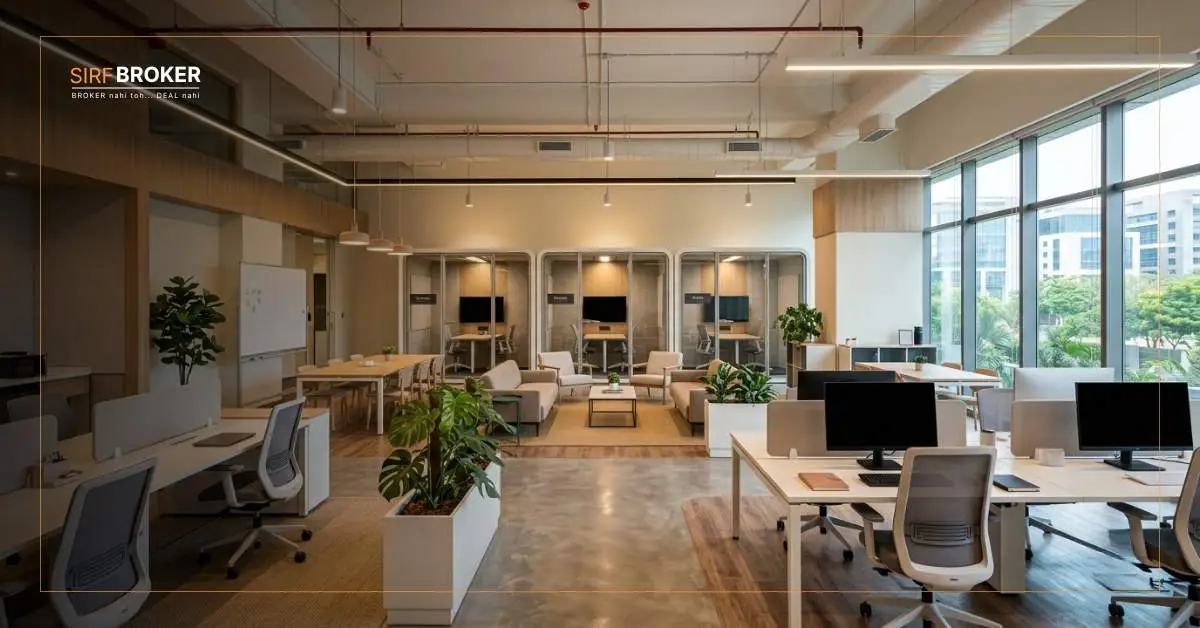
The 100 million sq ft milestone in India’s flexible office market has been widely noted. India’s total flex office stock now stands at 114 million sq ft, growing at a 23-25% compound annual growth rate since 2020, according to data compiled by Business Standard and Cushman & Wakefield in mid-2026. The market value of India’s coworking sector is estimated at $4.53 billion for 2026, rising to $8.7 billion by 2031 at a 13.94% CAGR, per Mordor Intelligence.
The number that changes how brokers should think about their business is not 114 MSF. It is 73% — the share of all office space searches that now focus on flexible workspace, per industry data. Traditional leased office — fixed term, direct with landlord, bespoke fit-out — is no longer the default search behaviour for the Indian office occupier. Flex is. That is a structural market shift that the leasing broker who only knows how to structure a direct lease must respond to now, not when the transition becomes more visible.
Coworking operators leased a record 8.6 million sq ft of office space in H1 2026 — up 32% year-on-year from 6.5 MSF in H1 2025, per Business Review Live. These operators are not end occupiers. They are institutional lessees who sublease to enterprise clients, GCCs, and SMEs. The broker who understands this two-layer market structure — and who has relationships on both sides of it — is operating in a segment that is growing faster than any other in India’s commercial real estate market.
| 114 MSF total flex stock. 8.6 MSF leased in H1 2026 — +32% YoY. 73% of all office searches now flex-first. $4.53B market value in 2026 → $8.7B by 2031. GCCs driving 45.5% of flex enterprise demand. Source: Business Standard, Mordor Intelligence, Cushman & Wakefield 2026. |
Why GCCs Are the Flex Market’s Biggest Driver
The most consequential development in India’s flex office market in 2026 is not the stock milestone. It is the occupier profile driving the growth. GCCs — the same entities driving the all-time record in overall office leasing — now account for 45.5% of all enterprise flex office demand, per Cushman & Wakefield’s Q1 2026 India Office Market Report.
This convergence — the world’s most sophisticated multinational occupiers choosing flexible workspace — destroys the narrative that flex office is a startup product or a cost-cutting measure. GCCs use flex for three legitimate, strategic reasons: speed (a managed office can be operational in weeks versus months for a direct lease fit-out), flexibility (headcount in India changes faster than lease terms allow), and risk management (a managed contract lets a GCC exit India operations without breaking a 9-year direct lease).
| THREE REASONS GCCs CHOOSE FLEX OVER DIRECT LEASING Speed → A managed flex office can be operational in 4-6 weeks. A direct lease with custom fit-out takes 6-12 months minimum. For a GCC launching a new India operation or rapidly expanding headcount, speed to productivity is worth the flex premium. Flexibility → GCC headcount in India is tied to global business cycles. A managed contract can typically be scaled up or down with 30-90 days notice. A direct 9-year lease cannot. The optionality has real financial value. Balance sheet treatment → Under IFRS 16, direct leases are capitalized on the balance sheet. Managed workspace contracts — structured as services — may qualify for off-balance-sheet treatment. CFOs at multinationals are aware of this distinction and factor it into the lease vs. flex decision. |
Average annual enterprise seat uptake is forecast to reach 200,000 seats in both 2026 and 2027 — a 25% increase over current levels — with GCC demand expected to account for nearly 50% of all enterprise seat take-up within this period, per industry projections reported in June 2026. The enterprise and GCC segment is not a secondary client for the flex operator. It is the primary growth engine.
The Market Is Now Profitable — and That Changes Everything
For the first five years of India’s flex market, the sector was a growth story with profitability concerns. Operators were signing large leases, building expensive fit-outs, and filling seats at occupancy levels that covered costs but did not generate consistent returns. That period has ended.
| India’s flex office sector surpassed 100 MSF as profits hit record highs, per reporting by allwork.space in June 2026. The combination of longer enterprise contracts, higher occupancy rates from GCC demand, and operational scale efficiencies has shifted the sector’s unit economics from breakeven to genuinely profitable. This profitability makes flex operators credible long-term counterparties for landlords — and credible intermediaries for brokers representing occupier clients. |
For developers and landlords who were previously reluctant to lease large floors to flex operators (due to concerns about the operator’s financial stability and exit risk), the profitability data changes the conversation. A flex operator with a large, profitable portfolio and institutional backing is a creditworthy tenant. The developer’s concern shifts from “will this operator pay rent?” to “will this operator maintain the building’s positioning in the market?” — a different and more manageable risk.
What the Market Structure Looks Like Now
India’s flex office market has consolidated significantly. The fragmented early market — hundreds of small coworking operators in every city — has been replaced by a structure dominated by a handful of large national platforms alongside a second tier of city-specific operators who know their micro-markets deeply.
The large national platforms — WeWork India, Awfis, Smartworks, IndiQube, Tablespace, and others — are signing 1-3 lakh sq ft leases in Tier 1 cities and managing enterprise relationships with GCCs at the national level. They have professional sales teams, standardised product specifications, and data-backed pricing. The small operator who rents a floor of a building and sells seats to freelancers is a different business category — not a competitor in the institutional market.
For brokers, this structure creates a clear hierarchy of relationships to build. At the top: enterprise and GCC workplace heads who are deciding between direct lease, managed flex, and hybrid arrangements. These relationships require genuine knowledge of how flex contracts are structured, what managed services include, and how to compare total occupancy cost between a direct lease with fit-out and a managed flex arrangement. For the fit-out cost comparison that every occupier conversation now requires, read: The Real Cost of Moving Offices: Why Rent Is Only Half the Story.
What Brokers Must Understand About Flex Commissions
Flex office brokerage works differently from direct lease brokerage, and brokers entering the segment for the first time consistently underestimate the commission structure differences.
In a direct lease transaction, the broker typically earns a commission equivalent to 1-2 months’ rent, paid by the landlord, on signing. In a flex transaction, the operator pays the broker — typically a per-seat commission for the first 12 months, often on a recurring basis as long as the client stays. This recurring structure is lower per-month than a direct lease commission but compounds over the enterprise contract’s duration. A 100-seat GCC enterprise contract at ₹12,000 per seat per month for 36 months, with a broker earning 2-month equivalent per seat: that is a different maths from a single-payment direct lease commission. Brokers who understand flex commission structures build a recurring income base that direct lease brokerage cannot.
For brokers who are newer to commercial mandates and want to protect their fee arrangements in writing, read: Don’t Lose Your Brokerage: The Commission Clarity Guide.
Sirf Broker POV
The 100 MSF milestone in India’s flex office market is a vanity number in isolation. What it represents — when combined with the 73% search share, the GCC occupier profile, and the sector’s profitability — is a complete structural re-ordering of how Indian office space is consumed.
The most consequential implication for brokers: the traditional office broker who only knows how to structure and negotiate a direct lease now represents a minority of the market’s demand. 73% of searches are flex-first. That means the broker who cannot have a credible conversation about managed workspace is already irrelevant to most of the enquiries in his market — he just hasn’t noticed yet because direct lease transactions are still larger in individual value.
The broker who builds genuine flex expertise — understanding operator products, enterprise contract structures, hybrid models, and the total cost comparison between flex and direct — positions themselves as the advisor for the full spectrum of office demand. The one who stays in direct lease-only territory is specialising in a segment whose search share is falling by 5-8 percentage points a year. Neither path is wrong in itself. But the choice should be deliberate, not by default.
The bigger opportunity is actually at the intersection: a broker who can advise an occupier on whether to take a direct lease, a fully managed contract, or a hybrid arrangement — and who has relationships with both flex operators and building landlords — captures the full decision, not just one option. That is the highest-value position in the current Indian office market. It is also the least occupied position.
Conclusion
India’s flex office market has crossed 100 million sq ft, established profitability, and entered a phase of institutional-quality demand led by GCCs and enterprise clients. Coworking operators leased 8.6 MSF in H1 2026 alone — a record — and the segment is projected to double to $8.7 billion by 2031. For brokers, the shift is structural: flex is now the default search behaviour for office occupiers. Building expertise in flex products, operator relationships, and enterprise contract structures is the adaptation required. The window for early positioning is still open. It will not remain open indefinitely.
For brokers who want to understand what commercial leasing mistakes lose deals and commissions, read: Common Mistakes in Commercial Property Leasing Deals.
Frequently Asked Questions
1. How large is India’s flex office market in 2026?
India’s total flexible office stock stands at approximately 114 million sq ft in 2026, growing at a 23-25% CAGR since 2020. The market value is estimated at $4.53 billion for 2026, projected to grow to $8.7 billion by 2031 at a 13.94% CAGR, per Mordor Intelligence. Coworking operators leased a record 8.6 MSF of office space in H1 2026, up 32% year-on-year.
2. Why are GCCs choosing flexible office space over direct leases?
GCCs choose flex for three primary reasons: speed (operational in 4-6 weeks vs 6-12 months for a direct lease fit-out), flexibility (managed contracts can be scaled up or down with 30-90 days notice), and potentially favourable balance sheet treatment under IFRS 16. GCCs now account for 45.5% of all enterprise flex office demand in India, per Cushman & Wakefield.
3. What percentage of office searches in India are now flex-first?
73% of office space searches in India now focus on flexible workspace, per industry data reported in June 2026. Traditional direct leasing is no longer the default search behaviour for Indian office occupiers — flex is. This represents a complete structural shift in how demand enters the market.
4. Is India’s flex office sector profitable?
Yes. India’s flex office sector reached profitability at scale in 2025-2026, driven by higher enterprise occupancy rates from GCC demand, longer contract terms, and operational scale efficiencies. Profits hit record highs as the stock crossed 100 MSF, per allwork.space reporting. This profitability has made flex operators credible long-term counterparties for building landlords.
5. How does flex office brokerage commission work compared to direct lease brokerage?
Direct lease brokerage pays a lump sum commission (typically 1-2 months’ rent) on lease signing, paid by the landlord. Flex office brokerage typically involves a per-seat commission paid by the operator, often recurring for 12 months or longer as long as the enterprise client stays. The recurring structure builds a compounding income base for brokers with enterprise flex clients under long managed contracts.
6. What is a managed GCC and how does it work?
A managed GCC is a structure where a flex space operator takes a direct lease from a building developer and provides a fully managed, turnkey office environment to a multinational’s India operation under a separate service contract. The GCC operates without managing a direct property lease, landlord relationship, or facility management. The flex operator handles everything — space, fit-out, internet, security, housekeeping, and often reception and administrative services.
Sources and References
- Business Standard — June 2026 — India crosses 100 MSF flex office space as GCC demand surges. business-standard.com
- Allwork.space — June 2026 — India’s flex office market surpasses 100M sq ft as profits hit record highs. allwork.space
- Tablespace — 2026 — India’s flex workspace market hits 114M sq ft in 2026; flex office market triples: managed office growth. tablespace.com
- Cushman & Wakefield — India Office Market Report Q1 2026 — GCC share of enterprise flex 45.5%; coworking operators’ leasing data. cushmanwakefield.com
- Mordor Intelligence — India Co-working Office Space Market 2026 — Market value $4.53B in 2026; $8.7B by 2031; 13.94% CAGR. mordorintelligence.com
- Business Review Live — 2026 — Coworking operators lease record 8.6 MSF office space in H1 2026, +32% YoY. businessreviewlive.com
Disclaimer
| This article is published by Sirf Broker for educational and informational purposes only. Flex office stock figures, leasing data, market valuations, and demand projections are sourced from publicly available third-party reports cited above and are subject to revision. This is not investment or transaction advice. |