

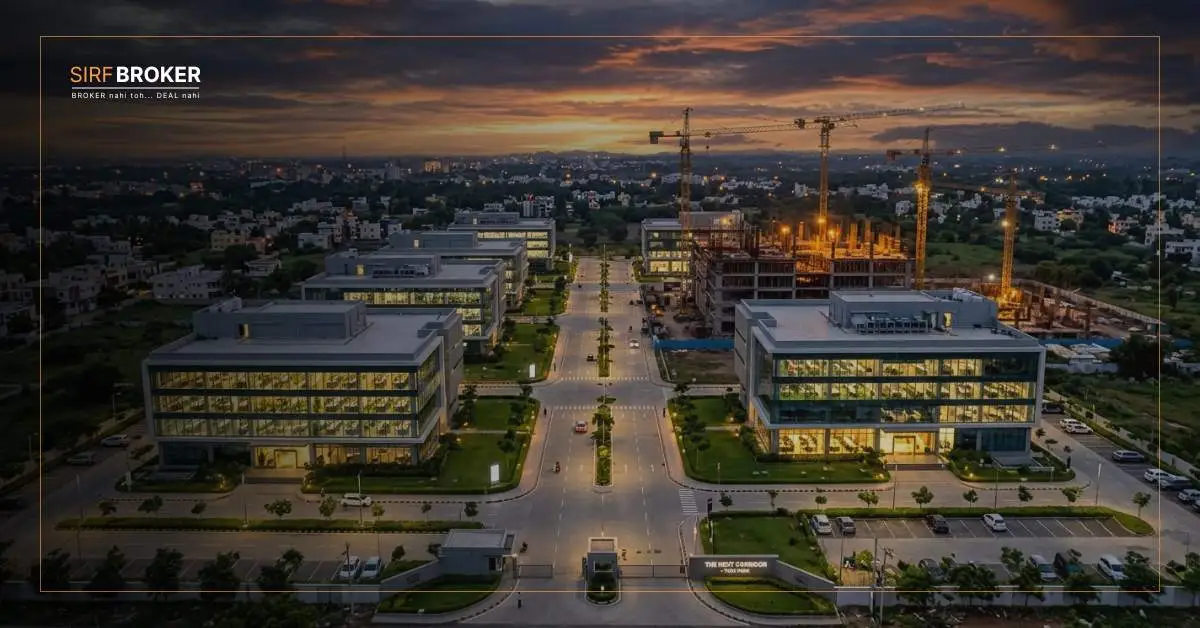
Global Capability Centres accounted for 38% of all Grade A office leasing across India’s top seven cities in 2025 — 31.3 million square feet, the highest volume ever recorded for the sector. In 2026, that share is expected to reach 40–50% of total Grade A demand.
Until recently, that story was concentrated in three cities: Bengaluru (34–39% of all GCC activity), Hyderabad (20–23%), and Pune. The economics were clear — deep talent pools, established tech infrastructure, and a concentration of global company precedent that made site selection straightforward.
That concentration is now shifting. In the first two months of 2026 alone, three new GCCs launched in Hyderabad. And the next wave — driven by talent cost pressures, infrastructure improvements, and deliberate government incentives — is pointing at India’s Tier 2 cities: Coimbatore, Ahmedabad, Jaipur, Indore, and Chandigarh.
For office brokers, this is not a future trend to monitor. It is an active transition to position for now.
| GCCs drove 38% of India’s Grade A office leasing in 2025 (31.3 MSF). In 2026, that share is expected to hit 40–50%. Bengaluru still leads, but Tier 2 cities are the next expansion wave — driven by talent cost advantage, infrastructure maturity, and state government incentives. Brokers who understand this geography first will own the mandates when they arrive. |
Why GCCs Are Moving to Tier 2 Cities
| WHY THE GCC EXPANSION WAVE IS REACHING TIER 2 Talent cost arbitrage → Engineering and analytics talent in Coimbatore, Indore, and Jaipur costs 25–35% less than equivalent talent in Bengaluru or Hyderabad. For a GCC with 500–1,000 seats, this is a material annual saving. Attrition advantage → Tier 2 cities have lower attrition rates than metro GCC hubs. Employees in Coimbatore or Chandigarh face fewer competing offers and have stronger reasons to stay — reducing the hiring and training costs that erode GCC productivity. Infrastructure now viable → Jaipur, Ahmedabad, and Chandigarh have metro rail. Indore’s Super Corridor has Grade A tech campus supply. Improved airport connectivity makes client visits from global headquarters manageable. State government incentives → Rajasthan, Gujarat, and Punjab are actively competing for GCC investments with land subsidies, single-window clearances, and IT park development. State-level competition for GCC anchors is intensifying. |
The Tier 2 GCC City Matrix — What Brokers Need to Know
| City | GCC Readiness | Talent Base | Office Supply |
|---|---|---|---|
| Coimbatore | High — engineering and manufacturing talent base, established IT/ITES clusters | Strong engineering graduates, lower attrition than metros | Growing — TIDEL-type parks, smaller floor plates (20,000–50,000 sq ft) |
| Ahmedabad | High — GIFT City gives Gujarat a global financial services credibility that transfers to GCC entry | Finance, IT, analytics talent pool expanding rapidly | GIFT City office supply is Grade A institutional standard |
| Jaipur | Medium-high — state government actively incentivising IT and GCC investment | Growing tech graduate output, proximity to Delhi talent market | Emerging — Mahindra World City and Sitapura Industrial Area key corridors |
| Indore | Medium-high — Super Corridor has planned Grade A tech supply | Strong IIT/engineering output, affordable lifestyle retention advantage | Super Corridor is the primary GCC-grade office corridor |
| Chandigarh / Mohali | Medium — Mohali IT park has existing GCC presence; planned expansion underway | Strong tech and BFSI talent, proximity to Delhi for senior leadership commute | Mohali IT Park, Knowledge City corridor |
What GCCs Actually Look for When Selecting a Location
| The GCC site selection decision is not made by the local India team. It is made or ratified by a global real estate or workplace committee sitting in the US, UK, or Europe. That committee uses a standardised matrix: talent availability and cost, office quality and scalability, connectivity (airport direct flights to home country), government incentives, and track record of other GCCs in the city. The broker who can present a structured case against that matrix — not just a list of available buildings — is the one who gets shortlisted for the mandate. |
Understanding the full cost structure of a GCC office deal — not just rent — is essential before approaching a mandate. The breakdown of what office fit-out and leasing actually costs beyond rent covers the financial components that GCC procurement teams always ask for.
How Brokers Should Position for Tier 2 GCC Mandates
1. Know the city before the mandate arrives. The broker who already knows which corridors in Coimbatore or Jaipur have Grade A supply, what floor plate sizes are available, and what the current rental range is — will close the evaluation meeting in one session. The broker who has to go back and check will lose the mandate to someone who doesn’t.
2. Build relationships with state investment promotion bodies. Rajasthan’s RIICO, Gujarat’s iNDEXTb, and equivalent bodies in other states receive GCC inquiry before the open market does. Being on these relationship maps matters.
3. Understand the GCC decision process. A 500-seat GCC office in a Tier 2 city is typically a 2–4 year lease commitment, ₹5–15 crore in fit-out, and a multi-department procurement decision. The broker’s role is not just finding space — it is coordinating between global real estate, HR, IT, and legal. Brokers who understand this complexity attract repeat mandates.
For brokers building market intelligence credibility with institutional clients, the framework in building a personal brand through market intelligence is directly applicable to the GCC mandate acquisition process.
Sirf Broker POV
The GCC Tier 2 expansion is not happening slowly. It is happening on the timeline of corporate real estate planning cycles — which means the mandates are being scoped right now, the site visits will happen in the next 12–18 months, and the lease signings will follow. Brokers who wait to develop Tier 2 GCC knowledge until they see an active mandate will arrive too late.
The opportunity is not just in the Tier 2 cities themselves. It is in being the broker who can credibly advise a GCC’s global real estate team on the India-wide location decision — which city, which corridor, why, at what cost. That is a different value proposition than showing buildings. It is advisory — and it commands a different relationship with the client.
India will host over 2,500 GCCs employing 2.8 million professionals by 2030 per JLL. The Tier 2 expansion of that story is underway. The brokers who own it will be those who started building city-level GCC market knowledge before the RFPs landed on their desks.
Conclusion
GCCs are India’s most structurally reliable office demand driver — and they are expanding into Tier 2 cities now. Coimbatore, Ahmedabad, Jaipur, Indore, and Chandigarh offer the talent cost, infrastructure, and government support that GCC site selection committees are increasingly scoring positively. The broker who builds this knowledge today owns the mandates when they arrive.
Before any commercial leasing conversation, understanding what common mistakes cost in office transactions is essential. The guide on common mistakes in commercial property leasing deals covers the pitfalls that cost both brokers and occupiers in office transactions.
Frequently Asked Questions
1. What share of India’s office leasing do GCCs account for in 2026?
GCCs accounted for 38% of all Grade A office leasing in India’s top seven cities in 2025 — 31.3 MSF, the highest ever. In 2026, this share is expected to reach 40–50% of total Grade A demand per JLL India GCC Guide 2026.
2. Which Tier 2 cities are attracting GCCs in India in 2026?
Coimbatore, Ahmedabad (especially GIFT City), Jaipur, Indore (Super Corridor), and Chandigarh/Mohali are the primary Tier 2 GCC expansion destinations. Three new GCCs launched in Hyderabad alone in the first two months of 2026.
3. Why are GCCs expanding into Tier 2 cities?
Four drivers: talent cost 25–35% lower than Bengaluru/Hyderabad; lower attrition rates; improved infrastructure (metro rail, airports, Grade A office parks); and active state government incentives from Rajasthan, Gujarat, and Punjab competing for GCC investments.
4. What does a GCC look for when selecting an Indian city?
The global real estate committee uses a standardised matrix: talent availability and cost, office quality and scalability, airport connectivity (direct flights to home country), government incentives, and precedent of other GCCs in the city. Structured market intelligence against these criteria is what wins the mandate.
5. How should brokers position for GCC mandates in Tier 2 cities?
Three actions: know the city before the mandate arrives (corridors, floor plates, rental range); build relationships with state investment promotion bodies (RIICO, iNDEXTb etc.) who receive inquiries first; and understand the multi-department GCC procurement decision process — not just the property search.
6. How large are GCC office requirements in Tier 2 cities?
Typically 20,000–1,00,000 sq ft for initial Tier 2 GCC setups, with expansion clauses. Floor plate sizes in Tier 2 cities (20,000–50,000 sq ft per floor) are smaller than metro Grade A, which suits the phased headcount ramp that most GCCs plan in new cities.
7. Which city will be India’s next major GCC hub after Bengaluru and Hyderabad?
Ahmedabad has the strongest near-term case — GIFT City infrastructure, Gujarat government support, and a growing BFSI and analytics talent base. Coimbatore is the strongest case for engineering and manufacturing-sector GCCs. Both are active markets in 2026.
Sources
- JLL India — GCC Office Guide 2026 — GCCs: 38% of Grade A leasing 2025 (31.3 MSF), 40–50% expected 2026. 2,500 GCCs by 2030, 2.8M professionals. jll.co.in
- Ceipal / New GCCs in India 2024–2026 — New GCC launches including Hyderabad activity. ceipal.com
- Zinnov — India GCC Story 2025 — Bengaluru 34–39% share, Hyderabad 20–23%. zinnov.com
- Kas Business Consulting — GCC India 2026 — Tier 2 expansion, state incentives, talent cost differential. kasbusinessconsulting.com
| Disclaimer: Published by Sirf Broker for educational purposes only. Not investment or transaction advice. All data from publicly available reports cited above. |