

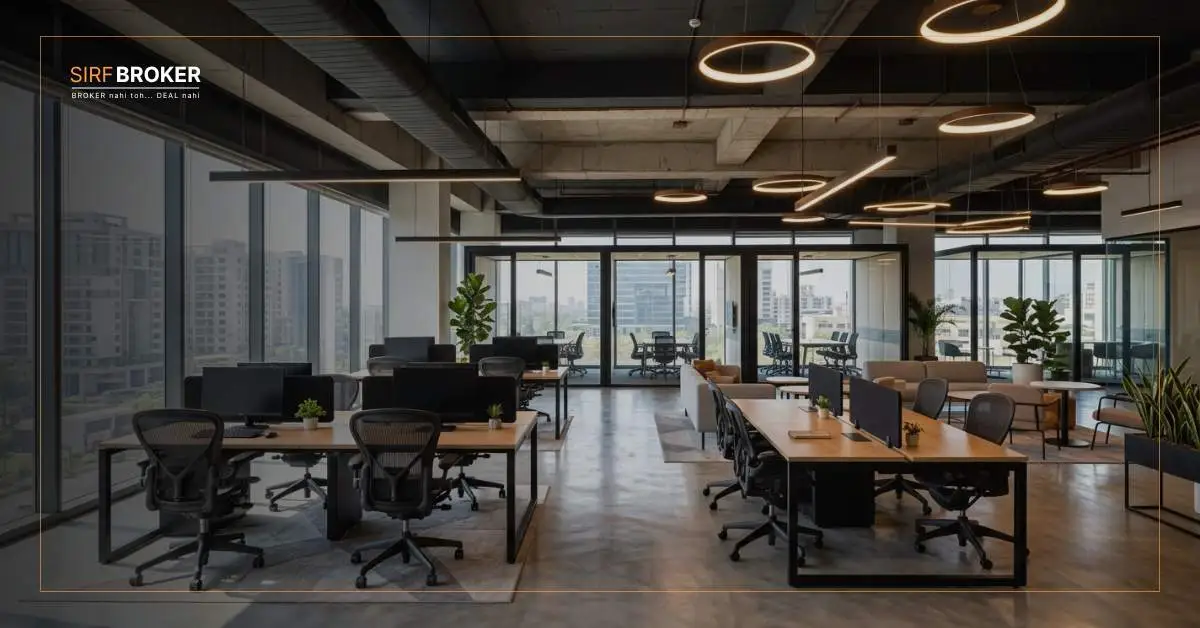
India’s flexible office sector is on track to account for nearly 20% of all Grade A office leasing in 2026, with total flex stock expected to reach 85–90 million square feet by year-end, according to Cushman & Wakefield India’s Q1 2026 Office Market Report. That is not a niche. At 85–90 MSF, India’s flex office market is larger than the total Grade A office stock of most APAC markets.
The shift is structural. Three years ago, flex space was where companies went when they couldn’t commit to a lease — a cost-optimisation tool for startups and project teams. In 2026, it is the deliberate first choice for GCCs entering new cities, multinational corporations optimising their real estate footprint, and Indian enterprises managing hybrid work models that make fixed-seat long-lease structures economically inefficient.
For brokers, this changes what a significant portion of the office mandate market looks like. For developers, it changes what a building needs to offer to compete for institutional tenants.
| India’s flex office stock projected at 85–90 MSF by end of 2026. Flex expected to account for 20% of all Grade A office leasing this year. GCCs, MNCs, and large enterprises — not just startups — are now the primary flex tenants. The broker and developer who treats flex as a fallback product is working with the wrong mental model. |
Why the Flex Demand Has Shifted to Enterprise
| WHY ENTERPRISE TENANTS CHOOSE FLEX IN 2026 Speed to market → A GCC entering a new city needs to be operational in 60–90 days, not 12–18 months. A fitted-out managed workspace solution gets the team in and productive while the long-term real estate strategy is developed. This use case alone is driving a significant share of Tier 2 GCC flex demand. Headcount uncertainty → Post-pandemic, no large enterprise has complete confidence in 3-year headcount projections. Flex allows companies to scale seats up or down without lease penalty. For HR-intensive GCCs where headcount fluctuates with project pipelines, this is financially material. Cost optimisation → A managed flex seat in a premium Grade A location costs more per seat than a conventional lease — but eliminates fit-out capex (₹2,500–5,000 per sq ft), reduces facilities management overhead, and converts fixed real estate cost to variable operating cost. For CFOs focused on balance sheet efficiency, this is increasingly the preferred structure. Hybrid work alignment → When 30–40% of seats are empty on any given day due to hybrid schedules, paying for 100% of conventional lease space is an obvious inefficiency. Flex operators absorb the utilisation risk — the enterprise pays for what it uses. |
India’s Flex Market by City — Where the Growth Is
| City | Flex Market Status | Key Demand Driver | Growth Outlook |
|---|---|---|---|
| Bengaluru | Largest flex market in India by stock | GCC expansion, tech startups, MNC regional hubs | Strong — enterprise demand absorbing new supply rapidly |
| Hyderabad | Second largest and fastest growing | BFSI GCCs, pharma sector, HITEC City expansion | High — supply additions being absorbed as built |
| Mumbai | Premium micro-market concentration (BKC, Lower Parel) | Financial services, media, consulting firms | Steady — constrained new supply keeps premium pricing |
| Delhi-NCR | Gurugram and Noida primary flex hubs | MNC regional offices, government-adjacent businesses | Growing — Gurugram Cyber City corridor strongest |
| Tier 2 Cities | Emerging — Coimbatore, Jaipur, Ahmedabad seeing first institutional flex supply | GCC first-entry, local enterprise, satellite offices | Highest growth rate from low base — significant opportunity |
What This Means for Brokers — The Commission and Mandate Reality
| Flex transactions have a different commission structure from conventional leasing. Operators pay referral fees — typically one month’s rent per seat referred — rather than conventional brokerage percentages. The deal is faster (days to weeks vs. months) and the ticket size per transaction is lower. Brokers who embed flex options into every office mandate — even where the eventual solution may be conventional — become the advisor the client calls first. |
Before presenting any office leasing solution, the full cost comparison matters. The breakdown of what conventional office leasing actually costs beyond rent — fit-out capex, deposits, escalations — is the context clients need to honestly evaluate flex versus conventional.
What This Means for Developers — The Building Design Imperative
| A Grade A building that cannot accommodate a managed flex operator — due to floor plate size, base building specification, or ownership structure — is losing 20% of its potential tenant universe. Developers building new commercial supply in 2026 should design for flex operator integration from the planning stage: larger floor plates (30,000+ sq ft), above-standard power supply, open ceiling options, and amenity infrastructure that attracts the enterprise-grade flex operators who deliver institutional tenants. |
Sirf Broker POV
Flex office in India has graduated from a category to a market segment. At 85–90 MSF and 20% of Grade A leasing, it is not a niche product for companies that can’t afford a real office. It is the deliberate choice of the most sophisticated real estate occupiers in the country — GCCs, multinational corporations, and large enterprises who have modelled the full economics and concluded that flex is the right answer for specific parts of their portfolio.
The broker who still thinks of flex as a fallback — something to offer when the conventional lease doesn’t work — is misreading the market. The broker who positions flex as a strategic option from the first client conversation, who can articulate the cost comparison between managed seats and conventional lease, and who has relationships with the leading flex operators — WeWork, Awfis, Smartworks, IndiQube, The Executive Centre — is the broker who captures a larger share of the mandate market.
The flex market will reach 20% of Grade A leasing because the demand is real and structural. Hybrid work is not reversing. Headcount volatility is not going away. Speed-to-market pressure is increasing. Brokers and developers who build the flex capability now are positioning for a share of a market that will still be at 20%+ of Grade A leasing in 2028 and 2030.
Conclusion
India’s flex office market is one of the clearest structural real estate stories of 2026 — 85–90 MSF, 20% of Grade A, enterprise-dominated, and growing. For brokers it changes mandate positioning. For developers it changes building design. Neither can afford to treat it as secondary.
For brokers building the institutional client relationships that generate GCC and MNC office mandates, the framework in how top brokers build personal brands through market intelligence is directly applicable to the flex and office sector.
Frequently Asked Questions
1. What is India’s flex office market size in 2026?
India’s flexible office stock is projected to reach 85–90 million square feet by end of 2026, accounting for nearly 20% of all Grade A office leasing, per Cushman & Wakefield India’s Q1 2026 Office Market Report.
2. Who is using flex office space in India in 2026?
Enterprise clients dominate — GCCs, multinational corporations, and large Indian enterprises. Flex is no longer primarily a startup product. GCCs use it for speed-to-market in new cities; MNCs use it for hybrid work right-sizing; enterprises use it to convert fixed real estate cost to variable operating cost.
3. Why are large companies choosing flex over conventional leases in India?
Four reasons: speed to market (60–90 days vs. 12–18 months); headcount flexibility without lease penalty; elimination of fit-out capex (₹2,500–5,000 per sq ft); and hybrid work alignment where 30–40% of conventional seats are empty on any given day.
4. Which are India’s largest flex office markets in 2026?
Bengaluru leads by total stock, followed by Hyderabad (fastest growing), Mumbai (premium micro-markets), and Delhi-NCR (Gurugram and Noida). Tier 2 cities — Coimbatore, Jaipur, Ahmedabad — are seeing first institutional flex supply with the highest growth rates from a low base.
5. How does flex office commission work for brokers?
Flex operators pay referral fees — typically one month’s rent per seat referred — rather than conventional brokerage percentages. Transactions are faster (days to weeks) and ticket sizes per deal are lower. Brokers who embed flex into every office mandate expand their addressable market.
6. What should developers do to attract flex operators to their buildings?
Design for flex from planning stage: larger floor plates (30,000+ sq ft), above-standard power supply, open ceiling options, and premium amenity infrastructure. A building that cannot accommodate an institutional flex operator is excluding 20% of its potential tenant universe.
7. Will flex office keep growing in India beyond 2026?
Yes — the structural drivers are permanent. Hybrid work is not reversing. Headcount volatility in GCC and tech sectors is structural. Speed-to-market pressure is increasing. Flex as 20%+ of Grade A leasing is a durable position, not a cyclical spike.
Sources
- Cushman & Wakefield India — India Office Market Report Q1 2026 — Flex expected ~20% of Grade A leasing; stock projected 85–90 MSF by end-2026. cushmanwakefield.com/india
- Bizzbuzz — India’s Office Market Holds Steady H1 2026 — GCC demand, flex growth context. bizzbuzz.news
- Business Connect India — Commercial Real Estate Trends June 2026 — Flex and hybrid work drivers. businessconnectindia.in
| Disclaimer: Published by Sirf Broker for educational purposes only. Not investment or transaction advice. All data from publicly available reports cited above. |